Showing posts with label Lizzie. Show all posts

Monday, 22 April 2013

Critical Evaluation-Question 1

In what ways does the media product use, develop or challenge forms and conventions of real media products?

By using equipment such as the Sony HDV1000 and Final cut express, we were able to follow conventions of continuity within our film when shooting and editing. We filmed over a period of around two weeks and in oder to keep continuty we had to refer to previous footage to ensure that the chracters were wearing the same clothes, accesories and had the same hairstyle. Furthermore, we had to make sure that the scenery was the same in each shot. Here, we mistakingly broke continuty as there is a cupboard door which is open in one shot and closed in another. We noticed this in post-production and we were unable to re-film this scene due to the fact that we had asked friends to star in the film and they were not available at appropriate times.


The 180 degree rule was one of the most important rules that we followed whilst shooting so the audience would be able to understand the positioning of the characters throughout the film. In some cases, breaking the 180 degree rule can be effective in the horror and thriller genres as it can confuse the audience, making them scared or uncomfortable- in this instance, it would be acceptable to make the audience confused as it creates suspension. However, this would not have been effective in our genre of film.


We also followed the rules of continuity during the editing process when showing a passage of time:
We have used a cross dissolve to display to the audience that we are cutting to a flashback or leaving the flashback.


We also used a fade to black to show a passage of time, to later that week. We used a fade to black rather than the cross dissolve so that it wouldn't confuse the audience into thinking that it was another flashback and that the story was going forwards, rather than backwards.


Towards the end of the film, we used a fairly common technique when editing narratives which don't follow a linear format or that display a longer period of time. We used text to display that a week had passed by since the previous shot, in order to represent a longer passage of time. We believe that by using this technique it will stop the audience from getting confused with the time differences used in the film.


We attained this idea from the film 'Love Actually':


Not only did we have continuity with the picture of the film, but we also used Final Cut Express to ensure continuity in sound. We used audio transitions on the split screen shot where we carried the sound of James' voice onto the split screen shot of Sally and James. James' dialogue needed to match his mouth movements to make the audience believe that they were actually having a phone conversation rather than it being  two separate conversations.

Furthermore, we used sound bridges to add diegetic and non-diegetic music to the film to make the film seem more realistic and make the audience feel the intended emotions. When adding music to our film I had to adjust the volume so it was appropriate for that scene. For example, in the party scene I had diegetic music to suggest to the audience that the characters were at a party and while Sally and George were having a conversation I had to make the music quieter and I used the effect 'lowpass filter' to make the music sound like it was in another room. Once they had finished the conversation I adjusted the volume of the music so that it was louder as Sally was walking upstairs. I believe that this was a very effective technique to use and it displays how I have used and developed my editing skills within our film.

Our non-linear narrative challenges continuity as we use flashbacks of a party to tell the story instead of showing the party first (in a chronological order) however as a group we decided that this would make our film stand out from others as we can convey our story in an unusual way.
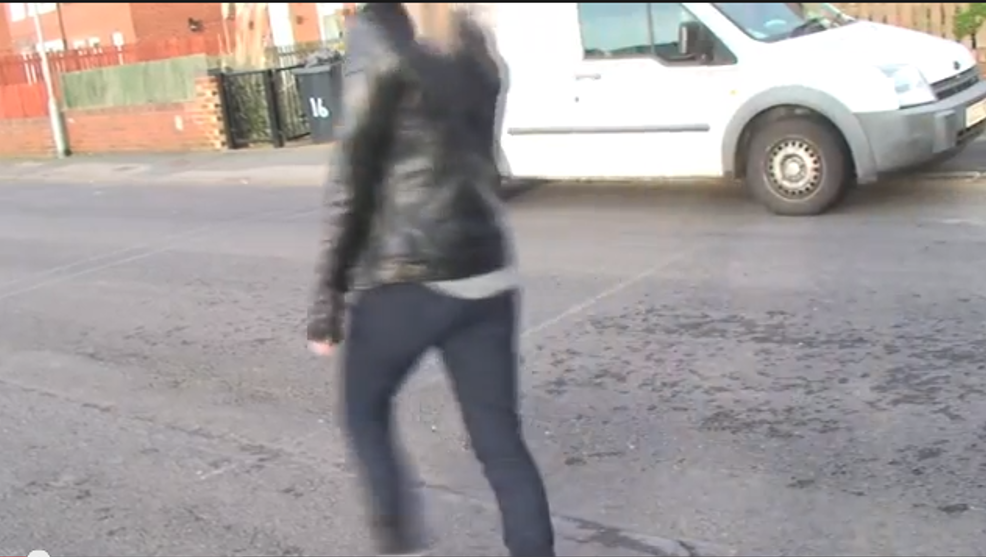
Moreover, we break the 180 degree rule by using a handheld, low angled shot of Sally walking to suggest that she is drunk. It breaks the rule because the camera moves to different sides of Sally, although we broke the 180 degree rule, it still makes sense to the audience and adds to the effect that she is drunk.


We believe that our film personifies the paradigm of drama as it involves real issues such as alcohol abuse, pregnancy and relationship breakdown. For example, Sally tells Lizzy, her best friend, that she is pregnant and that it isn't her boy friends baby but at the end of the film Sally tells James (her boyfriend) that it is his. The story builds tension because the audience want to know whether she will tell James that the baby isn't his and therefore, this follows the typical conventions of drama.

Moreover, our film incorporates the theme of 'good vs evil' further personifying the drama genre. For example, Sally is the evil character in our film and Lizzy is the good character, Sally cheats on her boyfriend, therefore displaying that Sally is the villain and Lizzy tries to convice her to tell James (her boyfriend) the truth, therefore demonstrating that she is the good character.


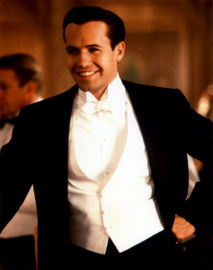
This theme is displayed in the majority of films as it creates tension within the audience as they will want the good character to beat the evil one and so they become interested in the film as they want to see if good beats evil. For example, in Titanic, Jack is the good character and Cal portrays the evil character.


GOOD                                                                                                  BAD


Within our film I believe that we have  achieved audience pleasure through entertainment purposes, according to Richard Dyers's theory of entertainment and utopia. His theory states that a film provides an audience with something they are lacking and that a film can provide an audience with a utopian solution. For example, if an audience is tired, it can provide them with energy, if they are bored it can provide them with intensity, if they are poor it can provide them with abundance, they lack understanding it can provide them with transparency and if they are lonely it can provide them with community. We use his tired concept in our film as we have a party scene with energetic, upbeat music and fast editing: 


By using this utopian solution our film may cure the potential tiredness of our audience as the fast-paced editing gives the film energy which will transfer to the audience. 

In addition, we use Dyer's intensity solution to cure boredom. This is present in our film as the audience will feel the highs and lows of the characters, for example, James see's that Sally has cheated on him, which is an extreme low for his character and we experience a high at the party when Sally is drinking alcohol. Our film would cure the boredom of our audience as they experience the highs and lows for various characters our film, keeping them interested in the film.


When considering Dyer's intensity solution we decided that our main character, Sally would be the one who creates intensity and tension. When designing Sally's character we took insparation from the film 500 Days of Summer. The main female character, Summer doesn't believe in true love and enters a relationship knowing that she won't commit to it. We used her belief of relationships to influence our story as each time Sally drinks the vodka, her veiws of the relationship change and she no longer wants to be in one. Hence the reason why she cheats on her boyfriend, James with George.


We also used Dyer's theory as a solution for loneliness as the party scene creates a community and the audience will feel like they are a part of the film. 
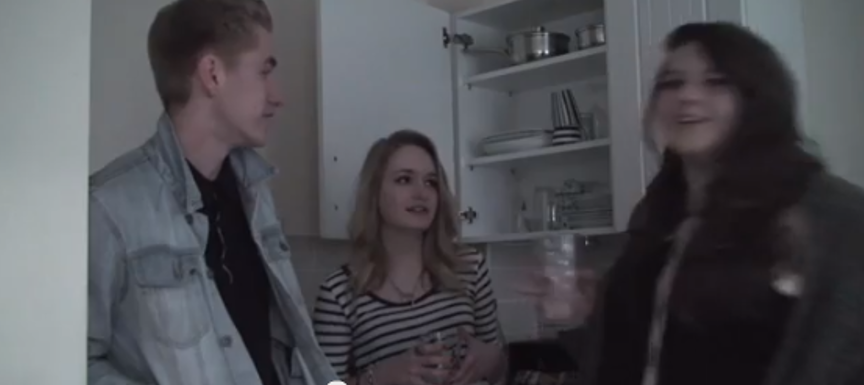
In these two shots you can see that there are a few people at the party. Even though we didn't have many people at the party, the diegetic music that you can hear implies that there are many people there. Previous scenes where Sally is drinking and the shot of her drinking with a friend may also cure the audience's feeling of loneliness as it signifies friends and community.  


Finally, we use Dyer's transparency solution to help the audience understand the characters feelings and emotions. We do this by using non-diegetic music, for example, in the final scene Sally tells her boyfriend, James that she is pregnant and we use sad music to project the emotions the characters are feeling to the audience. When looking for music to fit with the scene we looked for music that was soft and slow and this hopefully potrays the effect we were aiming to give. 


Sunday, 21 April 2013

Critical Evaluation- Question 2

I have answered question two by using a slideshare presentation: 

Saturday, 20 April 2013

Critical Evaluation- Question 3

In order to answer question three I decided to present my answer by using a Prezi presentation: 


Tuesday, 16 April 2013

Radio Trailer

Final Script


Day 2 of filming: Jess' house

Day two of filming: In Jess' house

The majority of our film will be filmed in Jess' house and here is the risk assessment so we can avoid any injuries to the cast and crew:


Cast and Crew required: 
  • Sally Herman (Jess Hardy)
  • James Oscar (James Lazenby)
  • Laura Cooper (Bethany Raynes) 
  • Lizzy Smith  (Lizzie Werboweckjy)
  • George Holson (George Rowe) 
  • Camera Operator (Lizzie Werboweckjy)
  • Director (Bethany Raynes) 

LOCATION PHOTOS: 

Character Profiles: 

Name: Sally Herman

Age:18

College: Barnsley College
Studying: English Language, Biology, Fine Art, Chemistry 
Family: Parents; Andy (Father), Samantha (Mother). Siblings; Ashley, 21 (Sister)

Character Traits:
Perfectionist/Artistic
Lucky
Loves the Outdoors/Adventurous
Genius 
Excitable
Shy
Friendly
Animal Lover 

Background information: Sally's favourite passtimes are song writing and playing the piano. Her best friends are James Oscar (the boy she is in love with), Olivia Batty and Jessica May. They have been best friends since they were children but only Sally and James will appear in the film. They enjoy going to party's and being outside, doing more dangerous activities such as rock climbing and absailing which they do most weekends. Moreover, Sally has won awards for her abstract art work which she does not only within college but in her spare time also. 

Name: James Oscar
Date of birth - 16/06/1995
Location - Barnsley
Studying 4 A-Levels at Barnsley College; history, english literature, english language, media
Part time job at Urban Outfitters, Meadowhall
Personality Traits - Shy
                               - Clumsy
                               - Hopeless romantic
                               - Lucky
                               - Procrastinator
                               - Artistic
                               - Bookworm
                               - Cultured
                               - Loves the outdoors
                               - Night owl
                               - Dog person
                               - Friendly


Name: Lizzy Smith played by Lizzie Werboweckjy
Age: 18
College: Barnsley college
Studying: Media studies, Biology, History, Psychology
Family: Parents, Bill (father), Jill (mother), only child
Occupation: Sales assistant at All Saints
Favourite Music: You Me At Six, Paramore, Greenday
Favourite films: Her favourite are romantic comedies for example, Ps, i love you, When Harry met Sally.
Favourite books: Harry Potter, The perks of being a wallflower.
Hobbies: Bike riding, play guitar, dancing
Character traits: Friendly, trustworthy, outgoing, intelligent
Role in the film: She is the best friend of Sally herman as they have grown up and gone through education together therefore, in the film, she is the one Sally approaches when she has a problem. Sally goes to her house because she has discovered she is pregnant and needs to tell her best friend for support. As they are having a conversation, flashbacks are included to tell the story of what happened better as Lizzie couldn't attend the party.


Name: Laura Cooper played by Bethany Raynes
Age: 18
College: Barnsley college
Studying: English language, Chemistry, Media studies and psychology
Family: Jack (father), Juliette (mother), Laura (sister)
Occupation: Sales assistant at WHSmiths
Favourite music: You me at six, Deaf havana, All time low
Favourite films:
 Mainly romantic comedies but also enjoys action films for example, 500 days of summer, Perks of being a wallflower, Taken
Favourite books: The fault in our stars, Curious incident of the dog in the night time
Hobbies: Shopping, playing keyboard and guitar
Character traits: Trustworthy, ambitious, good
Role in the film: She is a friend of Sally's and attends the party that is in the film. Beth is shown with Sally having drinks.


Name: George Holson played by George Rowe
Age: 18
College: Barnsley college
Studying: Maths, Physics, Biology and History
Family: Dave (father), Laura (mother), Jim (brother)
Occupation: Works behind a bar.Favourite music: Foo fighters, The Libertines, Kasabian
Favourite films: Actions films for example, The Dark Knight Rises, Die Hard.
Favourite books: He doesn't enjoy reading
Hobbies: going to the cinema, playing football and cricket
Character traits: Flirty, confident, friendly, outgoing
Role in the film: He is the boy that Sally cheats on her boyfriend with.


Props required: 
iPhone:


Earphones:


Vodka bottles x6 (roughly):


Settee:


Script required:


Shot list required:
8. Medium shot of Sally closing door.
9. Establishing shot of Sally and Lizziy sat on a settee.
10. Medium shot of Sally drinking.
11. Closeup of Sally drinking.
12. Closeup of Sally drinking.
13. Medium shot of Sally and Laura drinking.
14. Medium shot of Sally, Laura and George talking. 
15. Medium shot of Sally and George talking.
16. Unsteady close up of Sally walking up stairs. 
17. Unsteady close up of Sally and George walking up stairs.
18. Close up of Lizzy talking to Sally. 
19. Close up of Sally replying. 
20. Medium close up of James knocking on Sally's door.
21. Medium shot of James and George talking.
23. Medium dual shot of Lizzy and Sally talking.
24. Close up Sally.
25. Close up of Lizzy.
26. Close up of Sally.

Tuesday, 9 April 2013

Audience feedback on first draft of our film

We wanted to show an audience the first draft of our film so that we could make improvements based on what our target audience thought of the film. In order to gain audience feedback, I posted the video on social networking sites such as facebook and twitter:


I also created a questionnaire so I could direct the audience towards the kind of feedback we were looking for. I created the questionnaire online using Google docs so only I could see the feedback.

Here is the questionnaire:

I opened the responses on a spreadsheet so that I could compare each response:

As you can see here, the majority of the responses were from people aged 16-20 years and the majority who answered the questionnaire were also female which was our target audience when we were researching and planning our film. However we also gained responses from people aged 21-26+ both male and female. This feedback displays that not only did we achieve appealing to our original target audience but also to an older, male and female audience.
Furthermore, the results show that despite the fact that drama might not be everyone's favorite genre, only one person stated that they didn't find the storyline interesting. Once again showing that our film does not just appeal to our target audience, but a wider one also.


Moreover, one of our biggest worries when planning our film was making sure that the audience would understand the storyline. This proved to be a challenge because we had a non-linear narrative as we used multiple flashbacks in order to tell the story and so we feared that the audience would become confused with the narrative. However, the responses we gained all stated that they understood the storyline meaning that we wouldn't have to change the layout of our film.


 Here you can see what the audience thought of the film, what they liked and didn't like and how it can be improved. The majority of responses state that the use of flashbacks was an effective and interesting way to tell the story. Furthermore, the audience were interested in what would happen next after Sally had cheated on James at the party which is what were aiming to achieve when planning the story. However, many people commented on the volume of the music as they felt it was too loud in some places making it hard to hear what the characters were saying and therefore when we were re-editing the film we raised the voices of the characters in parts and lowered the volume of the music in order to make sure that the audience could clearly hear the characters. 
Moreover, people said thought that the opening scene of Sally walking was too long and so instead of editing it down we decided to make that our title sequence to make it more interesting to watch. 


Saturday, 6 April 2013

First draft of film, questionnaire

After completing the first draft of our film 'Delusion' we posted the video on the social networking sites; Facebook and Twitter to get some audience feedback. I decided to create a questionnaire so they knew what kind of response to give us.

Here is a link to the questionnaire:

Thursday, 4 April 2013

Audience Feedback on our film poster

This was the first draft of our film poster: 


To attain audience feedback for our film poster we posted a link to social networking sites such as Facebook and Twitter where friends and family could give their opinion on what they liked about it and what we could do to improve it. 

By putting our poster on these websites we were able to see what the general opinion was. We found out that people felt that we should have a significant background, which symbolises what the film is about, or showing an important location in the film. 


However, some of the feedback states that they find the white background effective as it makes the audience want to watch the film more, as it doesn't give away the storyline. Furthermore, they stated that it makes Jess, the main character stand out more.

This was the effect that we were going for as it then draws the eye to the cup of alcohol that she is holding which is central to the story. However, we will use the audience feedback in order to improve our poster and make it more eye-catching and interesting.

Editing our film

When editing out film we wanted to use different techniques to make our film stand out from other short films. To do this, when we were planning our story line, we decided to have a phone conversation so we could use a split screen to show both of the characters talking on the phone. 


To do this I put the video clips on top of one another and then I wire framed the shots so that on the left, you could see Jess on the phone and on the right you could see James. However, I had to edit the sound so that it matched the characters movements. This meant that I had to take the sound from the second clip and match it with the movement on the video. 


This was the final outcome of the edit. Both characters are in the center of their shot and it is clear to the audience that they are having a conversation with each other over the phone.


Moreover, the lighting in this shot looks very blue and therefore doesn't look realistic, especially because earlier in the film it was in broad daylight and so it caused a continuity issue which may also confuse the audience. In order to make the shot look more realistic I had to use a colour corrector to make it look like day time instead of early evening. 

 
As you can see, I added reds and oranges to make it look more realistic. 


As you can see in the next picture, the colour looks much better and therefore, looks like it is day time in the shot. This has then solved the continuity issue. 

Finally, the main location in our film is at a party. However, we were unable to gather people together to make it look like a real party and therefore, when I was editing I had to try to make sure that the audience were unable to tell that there was no one at the party. When filming we had to show Jess walking through a room and upstairs, so we used a handheld shot which only shows Jess' face. Because we used a handheld shot, it was unsteady, implying that she was drunk. To further demonstrate that she was drunk, and so the audience would be unaware that no one was at the party, when editing the shot I separated parts of it and cut it to a black screen to make it look like she was blacking out.